Why Green Space Works Like a Low-Dose Medicine
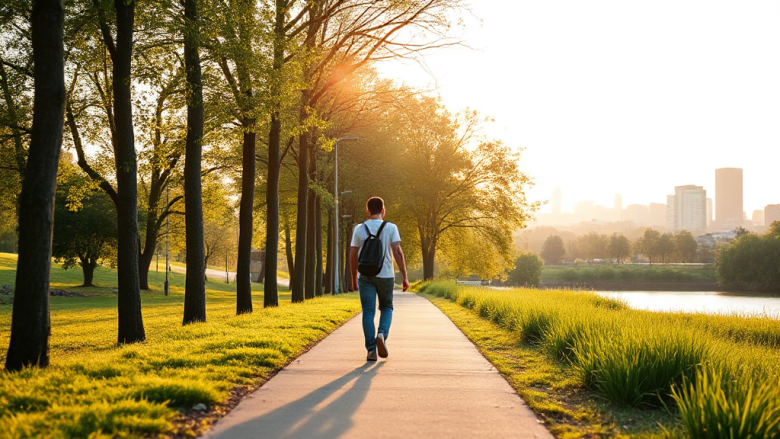
Maya used to ride the 42 bus three stops from her apartment to the clinic where she worked as a phlebotomist. In March, on a whim, she started getting off two stops early and walking the last stretch through a narrow riverside park instead of staying on the bus. She wasn’t trying to change her life. She just wanted to arrive less tense. By the eighth week, her smartwatch was recording a resting heart rate roughly four beats per minute lower than when she started, and the afternoon blood pressure readings she logged out of curiosity had dropped from an average of 128/84 to 121/79. Nothing else in her routine had changed. She was still sleeping the same six and a half hours, still drinking the same amount of coffee, still carrying the same workload. The only variable was twenty minutes of trees, water, and birdsong.
Maya’s experience is a small, informal anecdote, and anecdotes are not evidence. But her numbers point toward something that a growing body of research has been trying to pin down for decades: exposure to Nature behaves less like a vague wellness mood and more like a low-dose intervention, with measurable effects on the cardiovascular and endocrine systems. The question isn’t whether green space feels good. It’s whether it does something specific, at a specific dose, through a specific mechanism — and whether that dose is small enough to fit into an ordinary Tuesday.
The physiology behind the calm
The most studied mechanism is the stress axis. When you walk through a park, your body is receiving a stream of low-intensity sensory input that differs sharply from the input of a street or an office. Leaves move in irregular, non-threatening patterns. Birds call at unpredictable intervals. There is no traffic to track, no screens demanding a decision. This kind of environment appears to reduce activity in the sympathetic nervous system while gently increasing parasympathetic tone — the branch of the nervous system responsible for rest, digestion, and recovery.
The measurable signature of that shift is cortisol, the primary stress hormone. A frequently cited 2019 study in Frontiers in Psychology compared a 20-minute walk in a natural setting with an equivalent walk in an urban one and found that salivary cortisol dropped significantly more after the nature walk. Heart rate variability, an indicator of how flexibly the heart responds to the nervous system, tends to improve in green environments as well. Blood pressure follows. A meta-analysis published in Environmental Research pooled dozens of trials and reported average systolic reductions in the range of three to five millimeters of mercury after short-term exposure to green space — modest, but comparable to what some lifestyle interventions achieve, and achieved without medication.
There is also an attention component. The “attention restoration theory” proposed by Rachel and Stephen Kaplan argues that natural environments engage the mind in a soft, effortless way that allows directed attention — the kind you use to read a chart or hold a conversation — to recover. That recovery matters for stress because mental fatigue amplifies the perception of threat. When attention is depleted, small problems feel larger, and the body stays on alert longer.
What the cohort studies actually show
Observational research is where the picture gets broader and, in some ways, more convincing. Large cohort studies that follow people over years have consistently found that those living near more green space have lower rates of cardiovascular disease, lower all-cause mortality, and better mental health outcomes. A well-known analysis of nurses in the United States found that women living in the greenest areas had mortality rates roughly 12 percent lower than those in the least green areas, with the strongest associations for respiratory and cancer deaths. Dutch and Danish cohorts have reported similar patterns.
These findings come with an obvious caveat: people who live near parks may also be wealthier, more physically active, or less exposed to pollution. Researchers adjust for these factors, and the association usually survives, but adjustment is never perfect. What strengthens the case is that the effect appears even in experimental settings where people are randomly assigned to a nature walk or an urban walk. When the same person is compared to themselves under two conditions, the confounding largely disappears, and the blood pressure and cortisol differences persist.
There is also a plausible dose-response relationship. More time in green space tends to be associated with better outcomes, up to a point. A widely discussed 2019 study in Scientific Reports found that people who spent at least 120 minutes per week in nature were significantly more likely to report good health and high well-being than those who spent none. Interestingly, the benefit plateaued after roughly 200 to 300 minutes. The takeaway was not that you need a wilderness expedition. It was that two hours a week — about seventeen minutes a day — appeared to be a meaningful threshold.
The dose question
If green space is a medicine, what is the prescription? The evidence suggests a few practical parameters. Duration matters, but so does frequency. Short, regular exposures seem to outperform one long session, likely because cortisol rhythms and blood pressure respond to repeated small shifts rather than a single dramatic one. Twenty to thirty minutes, three to five times a week, is a reasonable starting point for most people, and it aligns with the 120-minute weekly threshold.
Intensity of the natural setting matters less than you might assume. You do not need old-growth forest. A tree-lined canal, a neighborhood park, a botanical garden, or even a well-planted courtyard can produce measurable effects. Some studies suggest that the presence of water — a river, a pond, a fountain — adds a small additional benefit, possibly through the soundscape. Biodiversity appears to help too: a park with varied plant life and birdsong tends to outperform a manicured lawn of uniform grass.
Movement amplifies the effect but is not strictly required. Walking combines the cardiovascular benefit of exercise with the nervous-system benefit of green space, which is why walking outdoors is often studied as a distinct intervention. But seated time in a park also shows effects on cortisol and mood, which is useful for people with mobility limitations or injuries.
For readers who want to build this into daily life, the strategy that works best is the one that removes friction. Pairing green space with an existing habit — a commute, a lunch break, a dog walk, a phone call — tends to be more durable than scheduling it as a separate task. This is where the broader idea of Gardening becomes relevant. Tending a few pots on a balcony, a small raised bed, or a community plot provides the same sensory profile as a park visit, plus a mild physical task and a sense of purpose. Studies of gardeners report lower cortisol and better mood compared with non-gardeners, though the usual caveats about self-selection apply.
Integrating green space into an ordinary week
The most useful framing is not “I should spend more time in nature” but “where can I insert fifteen minutes of green into a day that already exists?” A few approaches that hold up in practice:
First, break one commute leg. Getting off a stop early, parking a few blocks away, or walking a longer route through a park adds green time without adding a new appointment. Maya’s version of this was two stops. Yours might be one.
Second, relocate a routine. Take a phone call outside, eat lunch on a bench instead of at a desk, read a document under a tree. The activity stays the same; the environment changes. Because the physiological effect is driven largely by the environment, this substitution can be surprisingly effective.
Third, treat weekends as a top-up. If the workweek is thin on green time, a longer Saturday walk or a visit to a larger park can close the gap toward the 120-minute weekly threshold. The plateau in the data suggests you do not need to overdo it.
Fourth, consider indoor green as a supplement, not a substitute. Houseplants and views of trees have been associated with small improvements in mood and perceived stress, but the evidence is weaker than for outdoor exposure. They are worth having, but they do not replace a walk. If the goal is measurable change in blood pressure or cortisol, the outdoors is where the dose is delivered.
Finally, think about the general category of Health behaviors that green space supports rather than competes with. Time outdoors often displaces sedentary screen time, improves sleep timing through morning light exposure, and creates low-pressure social contact with neighbors. These are not side effects; they are part of how the intervention works.
Caveats, limits, and what not to expect
It would be dishonest to present green space as a cure. The blood pressure reductions in the literature are real but small — typically a few millimeters of mercury. For someone with hypertension, that is a helpful addition to medication and diet, not a replacement. The cortisol effects are similarly modest and tend to fade if exposure stops. Green space is a low-dose intervention, and low-dose interventions work best when stacked with sleep, movement, nutrition, and appropriate medical care.
Access is also uneven. Not everyone lives near a park, and not every park is safe, well-maintained, or pleasant. The research on green space equity shows that the neighborhoods with the least green space are often the ones with the highest stress burden, which is precisely the wrong way around. If your local environment is limited, a courtyard, a balcony with plants, a community garden, or even a route that passes a single large tree can still provide some benefit — but the honest answer is that policy and urban design matter here, not just individual choices.
There is also the question of how much of the effect is nature itself versus what nature replaces. A walk in a park is also a walk, and it is also time away from a screen. Disentangling these is methodologically hard, and researchers continue to debate the relative contribution. What is fairly clear is that the combination works, and that the combination is accessible to most people at a cost of roughly seventeen minutes a day.
Maya did not set out to run an experiment. She just wanted to arrive at work less tense. Eight weeks later, she had a small dataset of her own — a lower resting heart rate, slightly better blood pressure, and a habit she no longer thinks about. The evidence base behind her numbers is not as dramatic as a headline, but it is consistent, mechanistic, and dose-dependent. Green space behaves like a low-dose medicine because, in a meaningful sense, that is what it is: a small, repeatable input that nudges the stress and cardiovascular systems in a healthier direction. The prescription is not exotic. It is a park path, a few times a week, for about the length of a podcast episode.